Les 6 erreurs d’un joueur de badminton à corriger immédiatement

The 6 mistakes a badminton player needs to correct immediately

In short

  • The range: Astrox for power, Nanoflare for speed, Arcsaber for everything. Choose according to your game, not what your idol plays.
  • The stringing: factory stringing is useless, and new strings loosen with every session. If you play twice a week, re-string at least every month.
  • The weight: 4U for most players. 3U is for those with the physique and technique.
  • The stiffness: when you're starting out, go for flexible or semi-stiff. Stiffness comes with time.
  • The stringing: BG65 for casual play, thinner when you have more technique.
  • The tension: no more than 10 kg for casual play, no more than 11 kg for club D. This is the most common mistake.

I see these mistakes every day in the shop and on the courts. Among beginners, casual players, and even ranked players who have several years of badminton experience. It happens to everyone.

The problem is that they block your progress without you realizing it. You think your technique is wrong, when it's often your racket, your strings, or your tension. Here are the 6 mistakes I correct most often, with animations to help you understand.

The video | 8AknYeWr_ok

Mistake #1: choosing the wrong racket range

At Yonex, there are three main racket families: Astrox, Nanoflare, and Arcsaber. Other brands work pretty much the same way. What sets them apart is mainly where the weight is in the racket.

  • Astrox: the weight is in the head. It's like a small hammer: heavy, powerful, ideal for smashes. More for singles, or for big hitters in doubles, with already good basic technique.
  • Nanoflare: the weight is in the handle. The racket is light in the hand, fast, and maneuverable. I highly recommend it for doubles, where the shuttle moves fast and you need to react quickly with your hands.
  • Arcsaber: the balance is neutral. Neither in the head nor in the handle: it's the versatile racket, for singles, doubles, or mixed. The right choice when you're not really sure.

Choose your game in the animation to see which range suits you and where the balance point is located.

Animation: the balance point of the Astrox, Arcsaber, and Nanoflare.

The classic mistake: taking an Astrox because it's powerful, even though you don't like heavy rackets. As a result, you can't play with it, and that's normal. A Nanoflare or an Arcsaber would have been more enjoyable.

My advice for beginners: the Arcsaber 11 Play, around €70. Versatile, forgiving, slightly flexible, enjoyable to play. When you're starting out or playing casually, that's exactly what you're looking for.

If you only play singles, an Astrox can help you return it deep. If you mostly play front court in mixed doubles, a precise and maneuverable racket will help you with net touch. To go further, I made a complete guide to choosing your racket.

Mistake #2: not re-stringing your racket

This mistake needs to be split in two, because it affects different players.

You're starting out: your factory stringing is useless

A new racket often comes with factory stringing: thick, not tight at all. You can even spread the strings with your finger. It's there to look nice, not to play.

Lately, many players come to see me in the shop saying: "Geoffrey, I send my smashes with all my strength, but they don't go, the shuttle falls in the middle of the court." It's the stringing. All soft and too thick, it doesn't return anything to the shuttle.

The solution is simple: get your racket re-strung. No need for a high tension: a BG65 at 9 or 9.5 kg is already much tighter than factory stringing. It will change your life.

You play at a club: your stringing loosens without you noticing

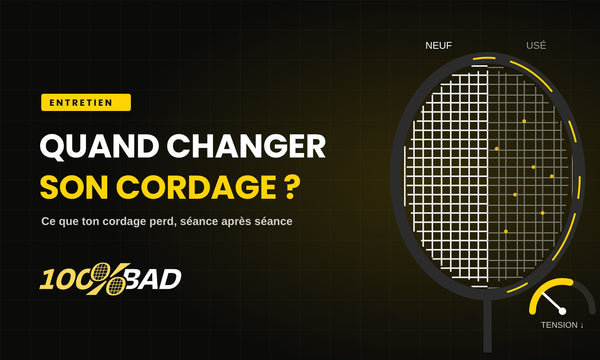
Whether you're D8, D7, R6, or R4, your new stringing is at 100% the day it comes out of the machine. But with every hit, the strings move. And even when your racket stays in your bag, the stringing loosens.

After your first practice, it's no longer at 98%. After a week, at 90%. You don't realize it, because your arm gradually gets used to it. After 3 months, your stringing set at 11 kg is no longer at 10 kg: it's all soft. Move the slider to see what happens.

Animation: the tension, power, and control of the stringing over the sessions.

In tennis, everyone talks about it: a player keeps their stringing for 15 to 20 hours of play, or about two weeks. In badminton, it's the same, but we talk about it much less. Me, I re-string before every tournament.

Without going that far, a good baseline: if you play twice a week, re-string at least every month. You keep a consistent hit, precision, and touch, instead of getting used to a stringing that feels more and more like a trampoline.

Calculator: how often to re-string your racket.

I know it has a cost, between €20 and €25 depending on where you go. But if you want good hitting quality, it's essential. I explain everything in my article when to change your badminton stringing.

Mistake #3: taking the wrong weight

15 or 20 years ago, almost all rackets were 3U, around 88 g. Today, brands make more and more 4U, around 83 g: a little lighter, more enjoyable to play, and easier on the arm.

3U is heavier, so more powerful. But it requires more technique to hit the shuttle properly. If you're starting out or playing casually, go for 4U instead, or even lighter if your arm hurts.

Animation: what the racket weight changes.

There are also very light rackets, around 73 to 78 g, like the Astrox 22 LT at Yonex. They are great for those who have elbow or shoulder pain: you don't feel anything, it goes by itself. The downside: you feel the shuttle less, especially at the net. It requires a little adaptation time.

To remember: 3U is heavy and technical. 4U is the good average. If your arm hurts, go for light rackets.

Mistake #4: choosing a racket that's too stiff

This might be one of the most important. When you're starting out, don't take a racket that's too stiff: choose a flexible or semi-stiff one.

A flexible racket is forgiving. If you're late and you hit badly, the shaft helps you: the shuttle still goes. You struggle less to return it deep, and you have fewer vibrations in your arm. A player who takes a racket that's too stiff from their first year will have arm pain and struggle to play.

The stiffer a racket is, the less the shuttle bounces on the stringing. On a flexible racket, there is a real trampoline effect: it goes easily, but a little to the right, a little to the left. On a stiff racket, the shuttle goes exactly where you want... provided you have the technique. Change the stiffness to see the difference.

Animation: the area where the shuttle goes according to the stiffness.

It's like a driver's license: you're 18, you just got your license, you don't take a Porsche. You will manage to drive, but you won't be good. Stiffness comes with time and training.

Mistake #5: taking just any stringing

Not all stringings are equal, and the most expensive is not necessarily the best for you. What sets them apart mainly is the thickness.

  • BG65 (0.70 mm), for beginners and casual play. It's one of the most popular stringings in the world. It's thick, so it lasts a long time. When you're starting out, you don't always hit in the center: a thin stringing would break quickly on these off-center hits. It's also flexible and enjoyable, it doesn't hurt the arm.
  • BG80 (0.68 mm), when you have more technique. Thinner and a little stiffer: you feel the shuttle better, it's more precise. If you've been playing for 3 to 6 years, you don't break it too often and your arm doesn't hurt, try it.
  • Exbolt 63 (0.63 mm), for technical players. Very thin, full of sensations, but fragile. I often see R6, R5, or D7 players put it on while their technique doesn't follow yet: they break it every week.

Warning: if you're starting out, if you break it often, or if you don't want to re-string too often, don't take a stringing that's too thin. You can compare all stringings in my guide to choosing your stringing.

Mistake #6: stringing your racket much too tight

I saved it for last, but it's the biggest mistake, maybe in all of badminton. Today, everyone wants to string tighter and tighter. 20 or 30 years ago, players played at 8 or 9 kg, and the one who put 10 kg had a high tension.

I even see it in the orders on my site: casual players asking for 11 or 12 kg. It doesn't make sense. Of course, there are exceptions, but in 95% of cases:

  • Beginner or casual: no more than 10 kg.
  • D8 or D7 club player: no more than 11 kg. And 11 kg is already huge.
  • N3, N2: there, you can go up.

Why? The tighter your stringing is, the more the effective zone of the racket face shrinks. At 13 kg, if you center all your shuttles, it's great. But if you're D8 and you hit all over the racket face, the shuttle doesn't go, it vibrates in the arm and you can't make the desired shot.

The worst is when you're late and you want to return it deep: at 14 kg, your off-center hit falls in the middle, and you're dead. At 10 kg, it's more forgiving, the shuttle goes further. Choose your level and your tension to see how many of your hits stay in the effective zone.

Animation: the effective zone of the racket face according to the tension and your level.

My tip when you change rackets: lower your tension by 1 kg. You played at 12 kg? Put 11 kg on the new one, while you get used to it, then go back up little by little. It's better to put less and re-string than to put too much, injure yourself, and not be able to play with your racket.

To find the right tension according to your level, I made a guide on tension.

To get started well | arc-saber-11-play, nanoflare-700-game, astrox-77-play, yonex-bg65, yonex-bg-80

Frequently asked questions

What badminton racket for beginners?

A flexible or semi-stiff racket, in 4U, around €60 to €80. The Arcsaber 11 Play is a very good choice: versatile, forgiving, and enjoyable. Avoid very stiff rackets and very head-heavy ones in the first year.

At what tension to string your racket when starting out?

Between 9 and 10 kg, with a BG65. It's tight enough for the shuttle to go, and forgiving enough for your off-center hits.

How often should you re-string your racket?

It depends on how much you play. If you play twice a week, re-string at least once a month. If you play casually from time to time, every 2 or 3 months, but never a year with the same stringing.

3U or 4U, what difference?

A 3U weighs around 88 g, a 4U around 83 g. The 3U is more powerful and more stable, but harder to move. The 4U suits most players.

If you have a doubt about your racket, your stringing, or your tension, write to me: I answer everyone. And if you buy your racket at 100%BAD, I string it in the workshop with the stringing and tension adapted to your level.

Back to blog

Leave a comment

The 6 mistakes a badminton player needs to correct immediately

By Geoffrey · 100%BAD09/11/202610 min read

Les 6 erreurs d’un joueur de badminton à corriger immédiatement

In short

  • The range: Astrox for power, Nanoflare for speed, Arcsaber for everything. Choose according to your game, not what your idol plays.
  • The stringing: factory stringing is useless, and new strings loosen with every session. If you play twice a week, re-string at least every month.
  • The weight: 4U for most players. 3U is for those with the physique and technique.
  • The stiffness: when you're starting out, go for flexible or semi-stiff. Stiffness comes with time.
  • The stringing: BG65 for casual play, thinner when you have more technique.
  • The tension: no more than 10 kg for casual play, no more than 11 kg for club D. This is the most common mistake.

I see these mistakes every day in the shop and on the courts. Among beginners, casual players, and even ranked players who have several years of badminton experience. It happens to everyone.

The problem is that they block your progress without you realizing it. You think your technique is wrong, when it's often your racket, your strings, or your tension. Here are the 6 mistakes I correct most often, with animations to help you understand.

The video | 8AknYeWr_ok

Mistake #1: choosing the wrong racket range

At Yonex, there are three main racket families: Astrox, Nanoflare, and Arcsaber. Other brands work pretty much the same way. What sets them apart is mainly where the weight is in the racket.

  • Astrox: the weight is in the head. It's like a small hammer: heavy, powerful, ideal for smashes. More for singles, or for big hitters in doubles, with already good basic technique.
  • Nanoflare: the weight is in the handle. The racket is light in the hand, fast, and maneuverable. I highly recommend it for doubles, where the shuttle moves fast and you need to react quickly with your hands.
  • Arcsaber: the balance is neutral. Neither in the head nor in the handle: it's the versatile racket, for singles, doubles, or mixed. The right choice when you're not really sure.

Choose your game in the animation to see which range suits you and where the balance point is located.

Animation: the balance point of the Astrox, Arcsaber, and Nanoflare.

The classic mistake: taking an Astrox because it's powerful, even though you don't like heavy rackets. As a result, you can't play with it, and that's normal. A Nanoflare or an Arcsaber would have been more enjoyable.

My advice for beginners: the Arcsaber 11 Play, around €70. Versatile, forgiving, slightly flexible, enjoyable to play. When you're starting out or playing casually, that's exactly what you're looking for.

If you only play singles, an Astrox can help you return it deep. If you mostly play front court in mixed doubles, a precise and maneuverable racket will help you with net touch. To go further, I made a complete guide to choosing your racket.

Mistake #2: not re-stringing your racket

This mistake needs to be split in two, because it affects different players.

You're starting out: your factory stringing is useless

A new racket often comes with factory stringing: thick, not tight at all. You can even spread the strings with your finger. It's there to look nice, not to play.

Lately, many players come to see me in the shop saying: "Geoffrey, I send my smashes with all my strength, but they don't go, the shuttle falls in the middle of the court." It's the stringing. All soft and too thick, it doesn't return anything to the shuttle.

The solution is simple: get your racket re-strung. No need for a high tension: a BG65 at 9 or 9.5 kg is already much tighter than factory stringing. It will change your life.

You play at a club: your stringing loosens without you noticing

Whether you're D8, D7, R6, or R4, your new stringing is at 100% the day it comes out of the machine. But with every hit, the strings move. And even when your racket stays in your bag, the stringing loosens.

After your first practice, it's no longer at 98%. After a week, at 90%. You don't realize it, because your arm gradually gets used to it. After 3 months, your stringing set at 11 kg is no longer at 10 kg: it's all soft. Move the slider to see what happens.

Animation: the tension, power, and control of the stringing over the sessions.

In tennis, everyone talks about it: a player keeps their stringing for 15 to 20 hours of play, or about two weeks. In badminton, it's the same, but we talk about it much less. Me, I re-string before every tournament.

Without going that far, a good baseline: if you play twice a week, re-string at least every month. You keep a consistent hit, precision, and touch, instead of getting used to a stringing that feels more and more like a trampoline.

Calculator: how often to re-string your racket.

I know it has a cost, between €20 and €25 depending on where you go. But if you want good hitting quality, it's essential. I explain everything in my article when to change your badminton stringing.

Mistake #3: taking the wrong weight

15 or 20 years ago, almost all rackets were 3U, around 88 g. Today, brands make more and more 4U, around 83 g: a little lighter, more enjoyable to play, and easier on the arm.

3U is heavier, so more powerful. But it requires more technique to hit the shuttle properly. If you're starting out or playing casually, go for 4U instead, or even lighter if your arm hurts.

Animation: what the racket weight changes.

There are also very light rackets, around 73 to 78 g, like the Astrox 22 LT at Yonex. They are great for those who have elbow or shoulder pain: you don't feel anything, it goes by itself. The downside: you feel the shuttle less, especially at the net. It requires a little adaptation time.

To remember: 3U is heavy and technical. 4U is the good average. If your arm hurts, go for light rackets.

Mistake #4: choosing a racket that's too stiff

This might be one of the most important. When you're starting out, don't take a racket that's too stiff: choose a flexible or semi-stiff one.

A flexible racket is forgiving. If you're late and you hit badly, the shaft helps you: the shuttle still goes. You struggle less to return it deep, and you have fewer vibrations in your arm. A player who takes a racket that's too stiff from their first year will have arm pain and struggle to play.

The stiffer a racket is, the less the shuttle bounces on the stringing. On a flexible racket, there is a real trampoline effect: it goes easily, but a little to the right, a little to the left. On a stiff racket, the shuttle goes exactly where you want... provided you have the technique. Change the stiffness to see the difference.

Animation: the area where the shuttle goes according to the stiffness.

It's like a driver's license: you're 18, you just got your license, you don't take a Porsche. You will manage to drive, but you won't be good. Stiffness comes with time and training.

Mistake #5: taking just any stringing

Not all stringings are equal, and the most expensive is not necessarily the best for you. What sets them apart mainly is the thickness.

  • BG65 (0.70 mm), for beginners and casual play. It's one of the most popular stringings in the world. It's thick, so it lasts a long time. When you're starting out, you don't always hit in the center: a thin stringing would break quickly on these off-center hits. It's also flexible and enjoyable, it doesn't hurt the arm.
  • BG80 (0.68 mm), when you have more technique. Thinner and a little stiffer: you feel the shuttle better, it's more precise. If you've been playing for 3 to 6 years, you don't break it too often and your arm doesn't hurt, try it.
  • Exbolt 63 (0.63 mm), for technical players. Very thin, full of sensations, but fragile. I often see R6, R5, or D7 players put it on while their technique doesn't follow yet: they break it every week.

Warning: if you're starting out, if you break it often, or if you don't want to re-string too often, don't take a stringing that's too thin. You can compare all stringings in my guide to choosing your stringing.

Mistake #6: stringing your racket much too tight

I saved it for last, but it's the biggest mistake, maybe in all of badminton. Today, everyone wants to string tighter and tighter. 20 or 30 years ago, players played at 8 or 9 kg, and the one who put 10 kg had a high tension.

I even see it in the orders on my site: casual players asking for 11 or 12 kg. It doesn't make sense. Of course, there are exceptions, but in 95% of cases:

  • Beginner or casual: no more than 10 kg.
  • D8 or D7 club player: no more than 11 kg. And 11 kg is already huge.
  • N3, N2: there, you can go up.

Why? The tighter your stringing is, the more the effective zone of the racket face shrinks. At 13 kg, if you center all your shuttles, it's great. But if you're D8 and you hit all over the racket face, the shuttle doesn't go, it vibrates in the arm and you can't make the desired shot.

The worst is when you're late and you want to return it deep: at 14 kg, your off-center hit falls in the middle, and you're dead. At 10 kg, it's more forgiving, the shuttle goes further. Choose your level and your tension to see how many of your hits stay in the effective zone.

Animation: the effective zone of the racket face according to the tension and your level.

My tip when you change rackets: lower your tension by 1 kg. You played at 12 kg? Put 11 kg on the new one, while you get used to it, then go back up little by little. It's better to put less and re-string than to put too much, injure yourself, and not be able to play with your racket.

To find the right tension according to your level, I made a guide on tension.

To get started well | arc-saber-11-play, nanoflare-700-game, astrox-77-play, yonex-bg65, yonex-bg-80

Frequently asked questions

What badminton racket for beginners?

A flexible or semi-stiff racket, in 4U, around €60 to €80. The Arcsaber 11 Play is a very good choice: versatile, forgiving, and enjoyable. Avoid very stiff rackets and very head-heavy ones in the first year.

At what tension to string your racket when starting out?

Between 9 and 10 kg, with a BG65. It's tight enough for the shuttle to go, and forgiving enough for your off-center hits.

How often should you re-string your racket?

It depends on how much you play. If you play twice a week, re-string at least once a month. If you play casually from time to time, every 2 or 3 months, but never a year with the same stringing.

3U or 4U, what difference?

A 3U weighs around 88 g, a 4U around 83 g. The 3U is more powerful and more stable, but harder to move. The 4U suits most players.

If you have a doubt about your racket, your stringing, or your tension, write to me: I answer everyone. And if you buy your racket at 100%BAD, I string it in the workshop with the stringing and tension adapted to your level.

Geoffrey at the stringing machine in the 100%BAD workshop

Need some advice?

I'll help you choose

Racket, string, tension: the guides help you see clearly, and I answer all your questions.